A fi sau a nu fi ... Bruxoman?
Eu bruxez/ Tu bruxezi/ El, Ea bruxeaza/ Noi bruxam/ Voi bruxati/ Ei, Ele bruxeaza...
Oare este o exagerare? Majoritatea dintre noi habar nu avem ca pe parcursul vietii am avut cel putin un episod de bruxism!
 .
Ce este bruxismul?
Muschii masticatori pot desfasura doua activitati de baza: functionale (ex: mestecat, inghitit, vorbit) si parafunctionale (= nefunctionale, ex. inclestarea sau frecarea dintilor, muscarea obrazului sau a buzelor).
Bruxismul este o activitate parafunctionala care se desfasoara inconstient ziua (bruxism diurn) sau noaptea (bruxism nocturn).
Fie ca citim, scriem, conducem masina sau ridicam un obiect greu, se poate intampla sa ne inclestam sau frecam dintii, fara a fi constienti ca acest lucru se intampla. Noaptea, evident, sansele de constientizare sunt cu atat mai reduse, mai ales in absenta unui observator extern.
 .
De ce se intampla acest “obicei” parafunctional?
Am vrea sa va putem oferi un raspuns simplu si concis...dar nu exista. De-a lungul anilor a fost si este un subiect controversat ce va fi cu siguranta obiectiv de studiu si pe viitor.
 .
Sa urmarim pe scurt, cele mai avizate opinii in domeniu.
Bruxismul ar putea fi interpretat ca o activitate fiziologica, organul masticator fiind o supapa ce permite eliminarea stresului acumulat cu avantaje majore in relaxarea organismului.
Hominizii primitivi, inainte de epoca uneltelor, obisnuiau sa-si extruzeze in lateral mandibula intr-o situatie stresanta. La Homo sapiens-ul civilizat acest obicei agresiv a fost eliminat de la nivel instinctual, dar aparent continua sa se manifeste pe parcursul somnului.
Fara indoiala stresul emotional joaca un rol important in activarea bruxismului. Cunoastem cu totii expresia “strangi din dinti si mergi mai departe”, solutie de compromis in situatii limita.
O alta teorie despre bruxism considera acest fenomen ca fiind un raspuns protectiv la interferentele ocluzale (contacte neadecvate intre dinti) si ne putem imagina procesul ca fiind un fel de auto-slefuire. Evident in acest caz ocluzia si structurile musculo-articulare ale sistemului masticator joaca un rol important in bruxism. De aici cu siguranta putem aprecia impactul pe care il pot avea coroanele si puntiile necorespunzatoare din cadrul tratamentolor stomatologice.
Anumite studii sugereaza chiar o predispozitie genetica pentru bruxism in timp ce altele gasesc o relatie cu alterari la nivelul sistemului nervos central, refluxul gastroesofagian, utilizarea medicatiei antidepresive, fumat, ingerarea de cafeina sau alcool si consumul recreativ de droguri.
Bruxismul la copii, mai ales in perioada dentitiei de lapte sau mixte, este un fenomen destul de frecvent. Personal consider valida teoria conform careia, cu rare exceptii, bruxismul in aceasta etapa a vietii este un fenomen fiziologic care are un rol bine determinat in definirea ocluziei in dentitia permanenta (felului in care se vor intra in contact viitorii dinti definitivi).
De ce ne-ar preocupa prezenta bruxismului?
Pe parcursul activitatii parafunctionale fortele aplicate asupra dintilor pot fi de aproape 4 ori mai mari decat cele din timpul activitatilor functionale, cu o directie ce nu respecta axul dintilor (adica nu sunt bine tolerate). Muschii care participa la activitati de acest tip “lucreaza” nefiziologic si ca urmare pot avea de suferit. De asemenea, lipsesc reflexele protective, cele care pe parcursului activitatilor fiziologice protejeaza stucturile dentare de posibilitatea de a fi deteriorate.
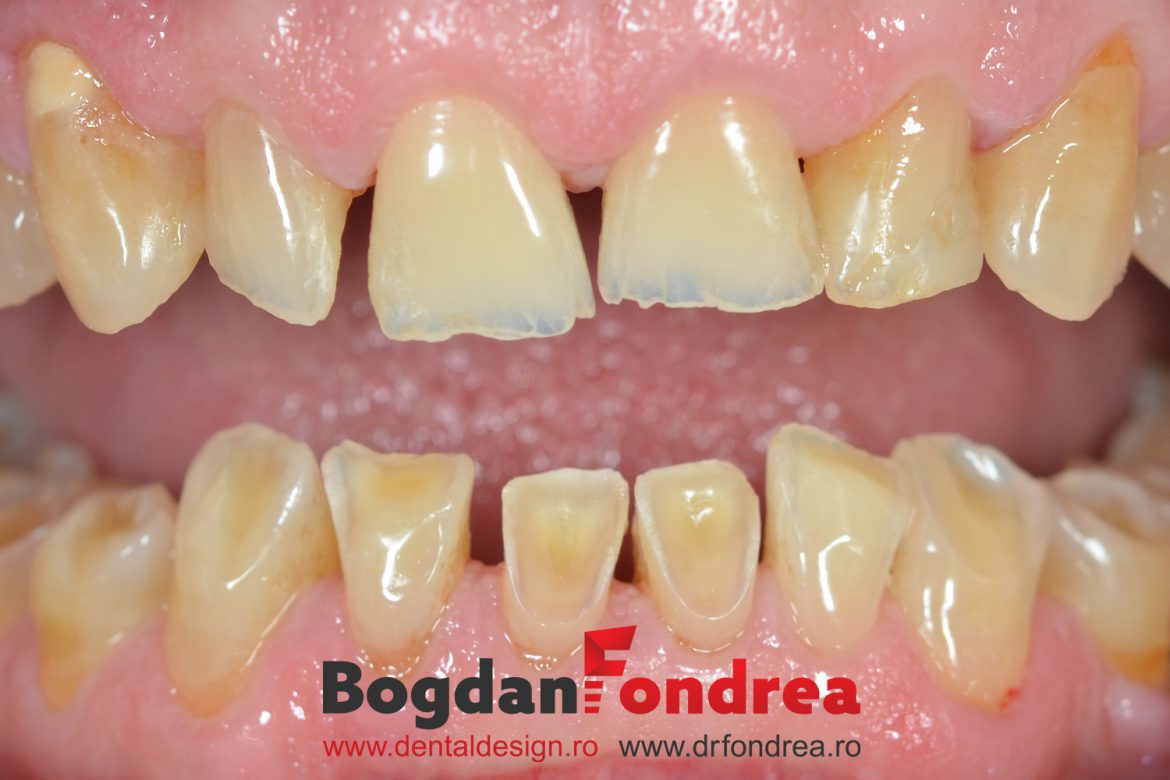
Cel mai comun efect al bruxismului este abrazia dintilor. Daca lipsa de substanta este importanta, dintii devin sensibili sau chiar se pot declansa episoade dureroase care pot duce la indepartarea nervului de catre medicul dentist.
Bruxismul poate fi in anumite circumstante un factor important in declansarea unor afectiuni ale articulatiei temporo-mandibulare (ATM) cu simptomatologie subiectiva variata: oboseala musculara a muschilor masticatori (senzatia ca “nu ma relaxez niciodata la fata”), durere de cap “in casca” sau la nivel cervical, discomfort care ajunge pana la durere la nivelul ATM, blocaje articulare, sunete la deschiderea/ inchiderea gurii, tinitus, etc.
.
Si evident intrebarea: tratam bruxismul? Cum prevenim posibilele complicatii?
La indivizii sanatosi bruxismul nu trebuie privit ca o afectiune, ci mai degraba ca un comportament ce poate fi factor de risc (si/sau protectiv) pentru anumite consecinte clinice.
Pacientul este adaptabil, dar nu toti sunt din punct de vedere biologic la fel...ceea ce intr-un caz este un fenomen absolut tolerabil poate fi un dezastru intr- un alt caz.
Solutiile ar trebui sa fie personalizate pentru fiecare caz, in functie in primul rand de motivul prezentarii la medic a pacientului si de colaborarea acestuia.
Ex: pacientul se prezinta pentru ca este deranjat de uzura moderata a dintilor,
  1. daca nu exista afectare ATM (articulatia temporo-mandibulara) si doreste sa-si refaca dintii frontali distrusi va trebui sa treaca printr-un proces, cu o durata variabila de timp de la caz la caz, cu o sina de stabilizare, poate tratament ortodontic, sa accepte echilibrari dentare,reconstructii la nivelul dintilor si sa incerce scaderea nivelului de stres din viata de zi cu zi.
  2. daca nu exista afectare ATM si doreste doar sa previna progresul uzurii va primi un dispozitiv de protectie dentara
  3. daca exista afectare ATM ... lucrurile se complica si mai mult si va trebui sa scriu pe viitor un articol in legatura cu acest subiect;)
Evident medicul dentist ar fi recomandat sa iasa din tiparul marginit in care priveste static dintii pacientului si ar trebui sa vada dintii ca fiind parte dintr-un intreg si cu conexiuni intr-un organism dinamic. intr-un context de acest gen, nu poate nicicand sa fie mai adevarata afirmatia: “chiar si o cea mai mica reconstituire dentara poate fi un factor de risc daca nu stii cum functioneaza tot sistemul”.
 .
 .
www.dentaldesign.ro
Bibliografie:
S.Sato, R. Slavicek. The masticatory organ and stress management. Int J Stoma&Occ Med. Dec 2008, Vol 1, Issue 1, pp 51-57;
R. Slavicek. Relation between occlusion and tempomandibular disorders: implication for the gnatologist. Am J Ortho&Dentofac Orthopedic. Jan 2011, vol 139, iss 1;
J. P. Okeson. Management of temporomandibular disorders and occlusion. - 7th Ed.
P. E. Dawson. Functional occlusion from TMJ to smile design. 2007 by Mosby;
F. Lobbezzo, J Ahlberg, K. G. Raphael, P. Wetselaar, A. G. Glaros, T. Kato, V. Santiago, E. Winocur, A. de Laat, R. de Loeuw, K. Koyano, G. J. Lavigne, P. Svensson, D. Manfredini. International consensus on the assessment of bruxism: Report of a work in progress. J Oral Rehabil. 2018; 1–8 x

What is orthodontics? What are orthodontic appliances?

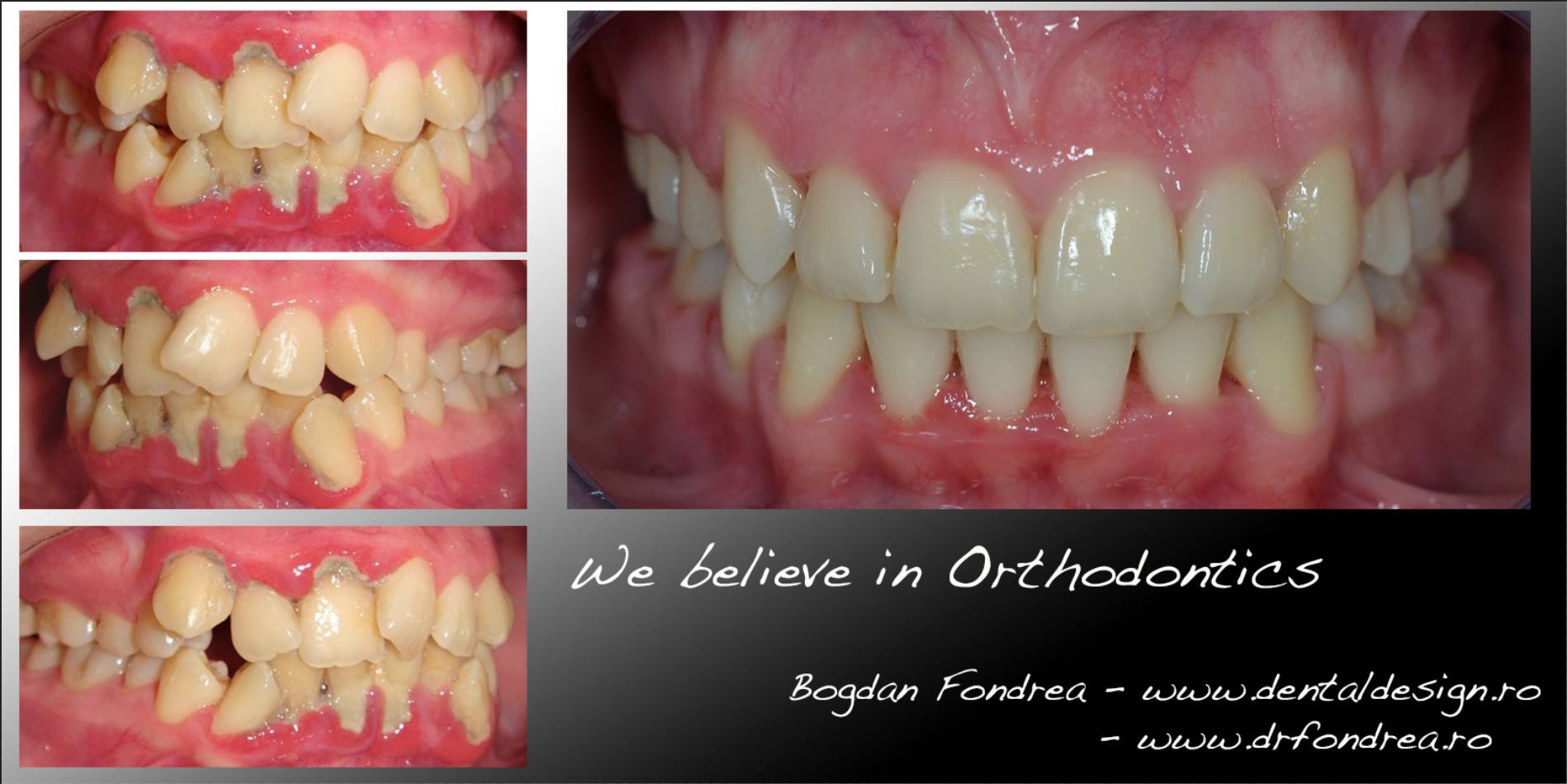
Orthodontics is a branch of dentistry that specializes in treating pacients with improper positioning of teeth when the mouth is closed (malocclusion) which results in an improper bite. Orthodontics also includes treating and controlling various aspects of facial growth (dentofacial orthopedics) and the shape and development of the jaw. An orthodontics specialist is called an orthodontist.

Orthodontic appliances are the means by which this treatment is performed. Orthodontic appliances are of several types (fixed or mobile, visible or invisible) and are recommend by the orthodontist for each individual case. It works for the realignment of the teeth, jaws retraining muscles and influencing growth. Orthodontic braces work by gentle pressure on the teeth and jaws. Depending on the severity of the problem, your dentist will recommend the appropriate type.

Malocclusion literally means bad bite. Some children's jaws and teeth do not develop properly. Malocclusion refers to crooked, misaligned teeth and a fault in the relation between the bottom and top set of teeth (the two dental arches). This may develop because of some injury inflicted to the teeth or facial bones, frequent thumb sucking, or for unknown reasons.Thumb sucking (or finger sucking) can result in localized deformation of the teeth and supporting bone. In order to restore a natural improvement, the thumb sucking habit has to be stopped.

Generally, malocclusions do not affect physical health, it is not a disease, but a variation in the normal position of teeth. However, it may have impact on the shape of the person's face and the appearance of their teeth, which can lead to embarrassment, a lack of self-confidence, and even depression. Severe malocclusion may affect eating, speech and keeping the teeth clean.

There are several types of orthodontic anomalies can be corrected:

  • The front teeth protrude - when the upper front teeth are positioned way ahead of the inferior; treatment not only improves the patient's appearance, but also protects the teeth from damage; people with protruding front teeth are more likely to injure them in sports, falling down, etc.
  • Crowding - if the patient's jaw is narrow, there may not be enough space for all the teeth. In such cases the orthodontist may have to remove one or more teeth to make room for the others
  • Open bite - when the teeth are clenched, there is an opening between the upper and lower teeth.
  • Asymmetrical teeth - the upper and lower teeth do not match, especially when the mouth is closed but the teeth are showing.
  • Deep bite (overbite) - when the teeth are clenched, the upper ones come down over the lower ones too much
  • Reverse bite - when the teeth are clenched, the upper teeth bite inside the lower ones
  • Underbite - the upper teeth are too far back, or the lower teeth a too far forward ("bulldog" appearance)
  • Crossbite - at least one of the upper teeth does not come down slightly in from of the lower teeth when the teeth are clenched; they are too near the cheek or the tongue
  • Spacing - there are gaps or spaces between the teeth, either because a tooth is missing, or the teeth simply do not fill-up the mouth (opposite of crowding)

Apart from the unsightly appearance, crooked teeth are harder to clean, they can be lost due to decay and periodontitis earlier than normal, and the chewing muscles' extra effort can lead to headaches, TMJ (temporomandibular joint) dysfunction and pain in the neck, shoulder and back.

The benefits of orthodontic treatment include a better oral health, a better look and a longer lifespan for your teeth.

The upside is that orthodontics is not a branch that is only for children. Thanks to modern techniques emerging, teeth can be straightened at any age. However, there are invisible orthodontic appliances that can be worn by people who do not want their braces to be that obvious.

Good oral hygiene is essential before any orthodontic treatment can begin. When devices are placed on the teeth, bits of food are much more likely to become stuck; the patient will need to brush much more carefully and more often to prevent tooth decay while treatment is ongoing. Patients who have not reached good oral hygiene standards beforehand are much more likely to suffer from tooth decay after the treatment begins.

When can the orthodontic treatment start?

Treatment will not usually commence until the child is about 12 or 13 years old; when the adult teeth have come through and developed fully. In some cases treatment may start a couple of years later if teeth problems had not become noticeable beforehand.

Children with a cleft lip and palate may require orthodontic treatment before their adult teeth have developed completely.

Adult orthodontic treatment should only begin after the pacient presents no cavities and no infections.

Assessment - the orthodontist will assess the state of the patient's teeth and make a prediction on how they are likely to develop without treatment. The following diagnostic procedures will be performed:

  • A full medical and dental health history
  • A clinical examination
  • X-rays of the teeth and jaw
  • Plaster models of the teeth

After the assessment is done, the orthodontist will decide on a treatment plan.

Examples of orthodontic appliances

There are two types of orthodontic appliances: fixed and removable ones.

Fixed appliances - the most common devices used in orthodontics. They are used when precision is important. Although the patient can eat normally with fixed appliances, some foods and drinks need to be avoided, such as carbonated drinks, hard sweets, or toffee. People who participate in contact sports need to tell their orthodontist, so that special gum shields can be made.

Examples of fixed appliances include:

Braces- consisting of brackets and/or wires and bands. Bands are fixed firmly around the teeth and serve as anchors for the appliance, while brackets are usually connected to the front of the teeth. Brackets are made of different materials (stainless steel, gold, platinum, various types of ceramic or composite) and are fixed to the dental surfaces with special adhesives. Wires in the shape of an arch pass through the brackets and are fixed to the bands. As the arch wire is tightened, tension is applied to the teeth, which over time moves them into proper position.

It is important that the movement of the teeth is done gradually in time, because the teeth are fixed in the bone. During tooth reposition changes occurr - apposition (bone formation) and bone resorption (bone loss) phenomenon. For this reason, a correct orthodontic treatment with braces is a long one - between 9 months - 1 year and a half - two years, maybe even 2½ years depending on the need for dental extractions, the complexity of the case and how big the anomaly is.

A patient sees the orthodontist about once a month so that the braces can be adjusted.

Children tend to prefer the colored braces, while adults usually go for the clear styles.

Fixed space maintainers - if the child loses a milk tooth, a space maintainer will stop the two teeth at either side of the spaces from moving into it until the adult tooth comes through. A band is fixed to one of the teeth next to the space, and a wire goes from the band to the other tooth.

Special fixed appliances - these may be recommended to control tongue thrusting or thumb sucking. Patients may find them uncomfortable, especially when they are eating. Experts say they should only be used if they are really necessary .

Removable appliances - these are typically used for treating minor problems, such as preventing thumb sucking or correcting slightly crooked teeth. They should only be taken out when cleaning, eating or flossing. Sometimes, the orthodontist may advise the patient to remove them during certain activities, such as playing a wind instrument or cycling.

Examples of removable appliances include:

Aligners - an option instead of traditional braces for adult patients. They are virtually unnoticeable by other people and can be taken out when patients brush their teeth, floss, or eat.

Headgear - orthodontic appliance attached to dental braces or a palatal expander that aids in correcting severe bite problems; there is a strap around the back of the head, which is attached to a metal wire in the front, or face bow. The aim is to slow down upper jaw growth, and keeping the back teeth in position while the front ones are pulled back.

Palatal expander - an appliance designed to make the arch of the upper jaw wider. The device consists of a plastic plate that is placed in the palate (the roof of the mouth). The plate has screws which exert pressure on the joints in the bones, forcing them outward, thus expanding the size of the palatal area (roof of mouth area).

Lip and cheek bumpers - specially made to relieve the pressure of cheeks or lips on the teeth.

Removable retainers - these are placed on the roof of the mouth. They are designed to stop the teeth from moving back to their original positions. If modified, they may also be used to stop children from sucking their thumbs.

Removable space maintainers - an alternative to fixed space maintainers.

Splints (jaw repositioning appliances) - they are placed either in the top or lower jaw and help the jaw close properly. Splints are commonly used for TMJ (temporomandibular joint disorder) syndrome.

Be smart! Be happy! 🙂

Bogdan Fondrea & Denisa Sava - www.dentaldesignclinic.co.uk

Contact

Str. Diaconu Coresi nr. 20, Timișoara, România
Telefon: +4 0741 015 959
E-mail: office@dentaldesign.ro

Înscrie-te la newsletter. Completează adresa de e-mail.

Copyright © 2026. Toate drepturile rezervate.
linkedin facebook pinterest youtube rss twitter instagram facebook-blank rss-blank linkedin-blank pinterest youtube twitter instagram